
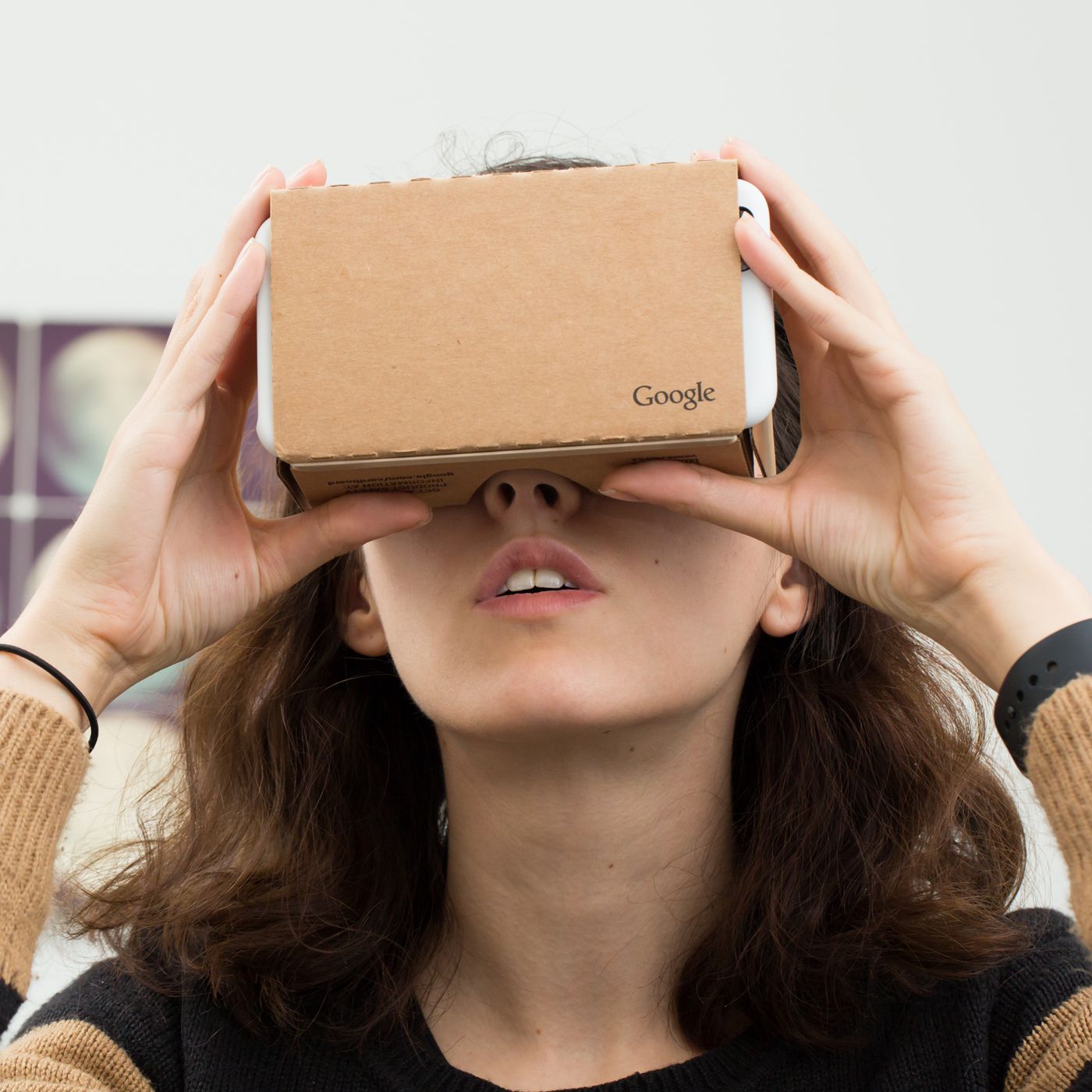
This week I’ve been getting to grips with the ‘Google Cardboard’ – the cheapest available form of VR.
Google Cardboard cost me £3.80 and arrived as a flat pack. The first learning curve was assembly. This in itself was an education experience – product design never really interested me, but if you don’t get to play with your new VR kit until you work out how it fits together, there’s motivation to learn! Google Cardboard can serve as an intro to flatpacks for children, something they will all face when they buy Ikea furniture and realise with dismay, they should have listened when their fathers explained the importance of toolkits…. Anyway, I digress. Having assembled my Cardboard, and squeezed my phone into it, I downloaded VR Jurassic.
Dinosaurs in your living room, what’s not to love?
I later installed the Google Cardboard app, but I struggled with this – I wasn’t able to activate interactive features without using my phone – which I couldn’t do while it was in my headset. The ‘Cardboard’ apps available for iPhone are limited compared to Android, probably due to Google owning the technology. Despite these limitations, I was quite impressed with the visual experience – it definitely is immersive.
Companies such as ClassVR and Prime VR are already integrating VR into classroom learning, transporting children everywhere, from the trenches of WW2, to the insides of the human digestive system.
But how could the tech be used for home learning?
While I was immersed in my dinosaurs, I forgot who was in the room, what room I was in and even what reading I should have been doing instead! The biggest struggle of many parents throughout this pandemic has been keeping children entertained and on task at home. The immersive nature of VR could combat this. Children could sit through pre-recorded lessons as if in a classroom, read textbooks, or dive into educational games. No more distractions, pure tunnel vision. Students may struggle to write notes while immersed, but examples such as BioDive demonstrate how note taking itself can be integrated into VR. Google Cardboard may not quite be there yet, but with innovative, educational game designs, VR really could be the future of learning at home.
VR is not for everyone however, with issues surrounding motion sickness and epilepsy. Notably, the tech is also only for those with excellent vision – the headset won’t fit over glasses and my partner (who only has vision in one eye) just saw blurry shapes when trying to use it. Having said this, VR can offer those without able bodies, a unique experience – getting a wheelchair onto a beach can be a struggle, but this tech gives those with limited mobility the opportunity to explore virtually.
Expensive VR headsets create far more interactive experiences, with controllers, trackers and multiplayer options. However, for it’s price and simplicity, I do believe that the Google Cardboard can offer a highly engaging home learning experience for many, blocking out distractions.
Header image: The Verge
 Rosie Roams
Rosie, do you think the effectiveness of VR in capturing children’s attention will reduce as the novelty wears off? I definitely agree that for many children is a great source of entertainment, when they can choose how to use it, but I wonder if the attention given to VR would struggle in the classroom! Especially if dinosaurs were replaced by math games, etc!
LikeLike
Yes Lucy I defiantly think that novelty can often be the key to attention and so it could loose its effectiveness over time
LikeLike
Tunnel vision of VR definitely could be a good way to keep children focussed. I like how you’ve commented on those with visual impairments too. Do you think surround sound experiences could be explored in the same way that surround experiences in VR are? Would be an interesting area to see what develops, and even in combination with VR!
LikeLiked by 1 person
I think surround sound should definitely be explored! I also read something interesting which said engaging the other sense more in VR would help to reduce the motion sickness it can cause!
LikeLike