
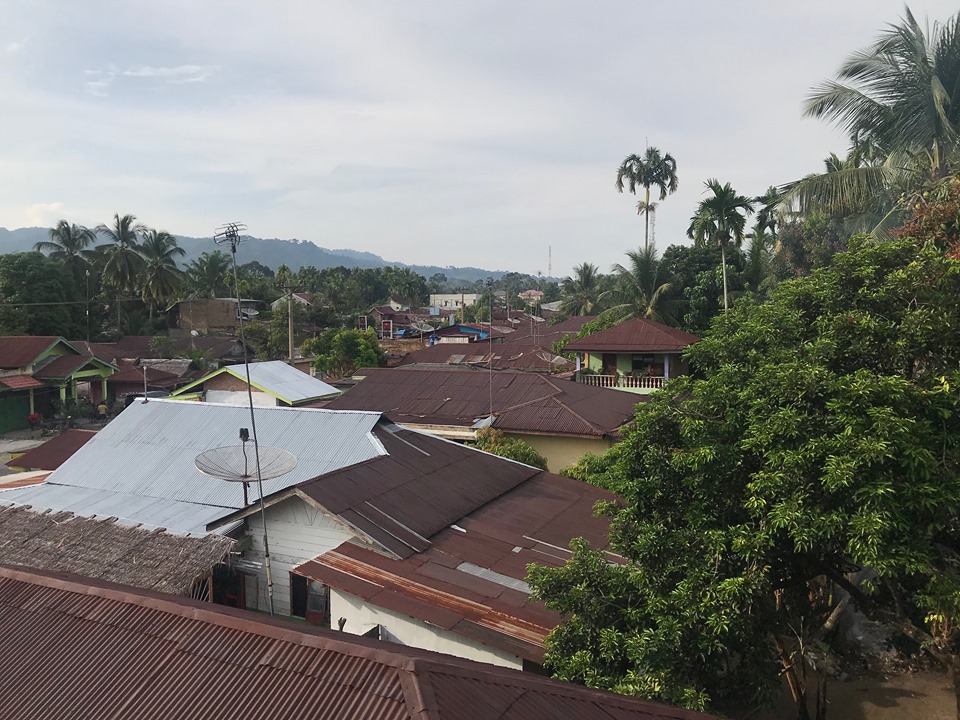
The past few weeks have been rather challenging for me. It seems that as soon as you get the hang of one thing here, something else falls apart!
While I feel that I’m finally getting the hang of my job and the culture, with few English speakers round in rainy season, the school can be a little lonely at times without volunteers here. Having said that, as my Bahasa improves it’s getting easier to spend time with local people. This morning was spent assisting next door who are building a new bathroom!
One challenge we have been having recently is working alongside different charities. You would think that all NGO’s working towards environmental protection and education would be able to work together quite easily, but sadly this doesn’t seem to be the case. It’s always about whose name is going on the poster, whose T shirts are we wearing and more importantly who is paying. Despite such issues, we did have a large collaborative effort last weekend between locals and many charities here, where over 200 of us spent Saturday morning on a mass litter pick. Our team was working in the river, where the majority of local people shower, brush their teeth and wash all of their clothes and dishes.
The river bed is almost completely covered in plastic and old clothes and the further downstream you head the worse it gets. The plastic is a lot easier to remove than the clothes, which are heavy from the water. Often when you pull up one item of clothing, you just move the sand enough to realise that there is another one hidden underneath.
This seems to me like a fair analogy for many of the problems here in Bukit Lawang. You start to fix one problem just to discover another. This is indeed the issue which many of the well intending charities here come up against. Many charities fly in Europeans for just a few days or weeks, who are full of exciting ideas but have no practical experience living in this culture or working with the environment. One of the most recent charity crazes seems to be ‘tree planting’ and we have repeatedly been asked to take our students to join mass tree plants – mainly so that another charity can gain lots of photos of young people out working on their project. While this sounds like a fairly good idea at first (how do we resolve deforestation, I know more trees) one of the largest causes of human animal conflict here in Sumatra is created by Monkeys and other such wildlife venturing into villages. Many charities who go to plant trees choose to do so at the edge of the Jungle, often planting fruit trees. While often these charities intend this fruit to be for animals, the villagers don’t always get this message and there have been many instances in the past of farmers and other people shooting Orangutans and other wild animals in an attempt to defend their crops. So while planting trees may help the planet, it’s crucial to consider what trees and where before any action begins. While action may seem more rewarding, often research, talking and thinking are the crucial in ensuring that the impact which charities are making is a positive one.
Something else which I have been finding challenging presently working in this sector is the issue of publicity. For charities to keep functioning, they need donations and to gain donations, they need to publicise what they are doing. Often the easiest, most effective and most emotive way of doing this is through photos.
Recently we started a project where we visited some of the most elderly and impoverished members of the community here in Bukit Lawang and the surrounding villages. Once a month we are visiting 20 people in their homes and giving them a small food parcel. Even having been here almost 6 months, I found this a very tough experience. People here very much have a hand to mouth existence, leaving no spare money for sickness or for old age. While the majority of those we met were up beat and very enthusiastic to invite us in, some individual situations were nothing short of heartbreaking. We chose not to take any photos that day to advertise what we were doing, however, without publicising actions such as these, it can be challenging to find the funding to continue them.
Every day that I am here is a learning curve and the surprises don’t always come from the culture or the country, but often from the realities of working in the sector I’ve always been interested in.
 Rosie Roams